Saturday, October 19, 2013

Final Project Proposal - Jin S Kim

Proposal

My semester project will be an attempt to explore myths and stereotypes Asian American and Asian immigrant women in mainstream media today.  The purpose of this project is to analyze the relationships between representation of American Asian women in major film (Hollywood) and its impact of objectification of Asian women on everyday life.

Representation of Asian women in American media is intricate; it includes ethnicity, race, culture and global identity (precisely in Western culture) of Asian American women’s gender and sexuality. Additionally, the alteration of the socio-economic status of Asian women in media has changed its reflection on representation of Asian women. Often, Asian women characters in popular American movies are consistently portrayed negative stereotypes.  I will discuss characters in various films that represent American Asian women with stereotypes.

The essay will seek to interrogate the very meanings and implications of media representation of Asian American women.  I will be presenting a short video clip that includes voice narration and variety of film footages. It will demonstrate the visual and aural evidence, to reinforce my theory and provide substance of my essay.

Introduction

Asian Americans are a minority group of the American population. Popular media exposure to Asian Americans lacks portraying actuality/reality of Asian Americans. Movies from the early century have been successful in portraying this stereotypical version of the Asian woman. Furthermore, the stereotypical characters in Hollywood/mainstream movie productions are often biased. Many of popular films do not reflect the true individuality of the typical Asian American living in America.


In films, Asian women characterize by weak, passive and often to be sexually and emotionally abused by (white) men. The term ‘China doll’ indicates the Asian woman is supposedly hypersexual, exotic, overly feminine and eager to please. This character appears countless times in popular movies.  The term ‘Dragon lady’ refers to an Asian woman who is regarded as seductive but at the time she is untrustworthy; the female version of the Asian bad guy. She has the power to mesmerize her male rivals, and also has the power to remove them when they are no use to her.


Lucy Liu plays a dragon lady character in movie Charlie's Angels

Asian women in movies often recognized either China doll or dragon lady character: If it's not about her male partner abusing her; it is about her success with seducing the male characters into self-destruction. Therefore, she would either gain sympathy or antipathy from the audience.


Resources

Book:
Transnationalism and the Asian American Heroine, Edited by Lan Dong. McFarland & Company, Inc., Publishers. 2010.

Article:

Asian 'It' Girls Say So Long to the Dragon Lady, Jennifer Tung. The New York Times
May 21, 2000, Sunday.

Journal:

Visual Pleasure and Narrative Cinema, Mulvey, Laura. 1975.

Psychotherapy for Asian American Woman Warriors, Jean Lau Chin.

 “Lines of Flight”: Reterritorializing Asian American Film and Media Studies, Kent A. Ono.
American Quarterly, Volume 64, Number 4, December 2012, pp. 885-897 (Article)

Paying Attention: Feminist Film Studies in the Twenty-First Century, Adrienne L. McLean. Cinema Journal 48.4 (2009): 144-151. Project MUSE. Web. 12 Oct. 2013.

Video:

Asian and Asian American Women's Media Stereotypes;


Term Project Proposal: "Hair: A Life of Its Own"

My term project, entitled HAIR: A Life of Its Own, will address the social and political implications of hair, particularly as they apply to normative (Eurocentric) standards of beauty and Black females in the United States. By critically examining hair and its function in perpetuating normative standards of beauty, in addition to its significances to politics and social resistance movements, my project will bring awareness to the impact that hair has on identity construction and demonstrate how it can be used as a tool for resistance within our social, cultural, economic and political framework.

The Project
The purpose of my project is use media as an advocacy tool to promote a diverse and board spectrum of beauty, which challenges normative (Eurocentric) standards of beauty and celebrates cultural difference. To that end, a fictitious company will be created and it will be launching a new initiative designed to promote beauty by celebrating non-normative standards and using hair as the focal point to educate and empower Black females.

A media kit and power pointe presentation will be created to support the launch of this new initiative and these components will serve as the core of the project. The media kit will include the company brochure, overview, press release detailing the launch of the initiative, the “ask” letter soliciting involvement, a mock up print advertisement promoting the initiative, a current media related piece to highlight hair’s significance within our culture and a visual aid (i.e. picture slide show).

Considering that the media kit is primarily a composite of print documents, a power pointe presentation will serve as visual aid to support my in-class presentation. This power pointe presentation will highlight the components of the media kit, in addition to incorporating commercials, snippets from film and advertising to support my claim. This aspect of the project will be publishable to the public and will also include the visual aid included in the media kit.

Media Kit Component Breakdown
(Please be aware that the organization that will be highlighted in my project will be fictitious; however the appearance of the company will be authentic (i.e. name, logo, contact info). I will serve as the founder of this company and will be the person providing the information and making the ask)
 
Company Brochure: This will highlight who the company, provide general background information, mission statement, services we offer/work we do, contact info and include company tag line.
Company Overview: This will include a brief history of the company, give founder’s bio and include the mission and vision statement.
Press Release: This will detail the actual initiative that’s being launched, identify its purpose, provide general information to the public and inform them to how they can get involved.
The “Ask” Letter: This letter will be addressed to Professor Cacoilo , addressing the claim of the overall project, as well as incorporating a critique of media and its impact on Black female identity construction. It will then identify how she/the class can get involved with the company and cause.
Mock-Up Print Ad: This is an ad used to promote the company and initiative. Ideally if this was a real campaign it could appear in newspapers, magazines and on-line.
Relevant Media Piece: This would simply be a current piece in the media depicting that hair is an issue for women. This piece serves as supplemental support to the overall cause and theme of the project.

Distribution
Three copies of the media will made; one to be given to the professor and two to be shown to the class, complementing the power pointe presentation. A blog post explaining the overall project will accompany the power point presentation, contents/images from media kit and will be linked to the class blog to be published.

How It All Fits
This project is inspired by my CUNY Pipeline Thesis, “Visual Truth, Is It Real or Fake? Understanding the Impact Mass Media has on Black Females and SeIf-Identity Construction”. It is my hope that my thesis will help to bring attention to marginalized groups and issues, not only within the academy but within our everyday lives. While the company used in my project is fictitious, community advocacy is a passion of mine and creating a company that works to promote this cause or those similar is a long-term career goal. This project has allowed me to find harmony in both of my career paths. By having a degree in Business with a concentration in marketing, the first ten years of my career were all about sales, strategy and promotion. However finding comfort in academics and social justice sometimes creates disjointment with a business background. This project has allows me to bring the best of both my worlds to the forefront.


Rough Final Project Proposal


            For my semester project, I will be doing a presentation (TBD) on the way alcohol is advertised to women. It is possible that I may broaden that out a bit to include all food and beverage, but the goal is really to stay within the limits just alcohol.  Yes, advertising is important in many ways, but I feel the way advertising agencies depict the relationship between women and booze is very unfair.  I can’t say that this picture is necessarily inaccurate the majority of the time, but only because I feel the real-life relationship has been shaped by the images the ads give to women.  They are so over-the-top, using ridiculous stereotypes of “femininity” to sell a sub-par product that it would be comical if it weren’t really sad.
            This is not only limited to advertising, but also the way we view female bartenders.  One typically associates a male bartender as being knowledgeable (in a nicer bar/restaurant), whereas one may expect that a female bartender was higher just to be eye candy. Until somebody can prove that men inherently have a better palate and capacity to taste and understand drinks, I think alcohol is just as much as a woman’s arena as it is a man’s.
               To follow up with that first article, I did some of my own comparisons of ads, and what found more or less what expect:  Ads geared toward men either focus on the quality of the product or the fact that drinking it will enhance his status.  Ads for women are mostly just splashes of color that attract the eye, but dont talk about product itself out, and therefore assume that a woman has little to no interest in it.  As always, the main message of an alcohol as geared toward women is "drink this because its sweet and people will think you're sexy".
           One of the most absurd things I found was Mike's Hard Lemonade rolling out with a Pink Hard Lemonade, aimed at women because it has the pink breast cancer ribbon it.  The second article addresses this, discussing how this is particularly offensive because there is a link between drinking and breast cancer. 
              I also wanted to discuss the history of women and alcohol/bartending.  That's where the last article from hte Wall Street Journal comes in.  It discusses how not too long ago, there were places in the country where it was illegal for women to bartend.  Of course now there are plenty of female bartenders, but more often than not, it seems they are hired not for their knowledge, but there ability to draw in customers with their looks.  This is something I will still have to research/work at to prove.

♡♥ final project proposal♥♡


Since the advent of social media, young people have had the opportunity to construct an online idealized form of the “self” for others to behold. Based on the celebrity deities and worship of appearance, new technology has facilitated the way young girls can present themselves. The deadly trinity, Facebook, Instagram and Twitter are used to create an identity to hide behind, covering blemishes both inside and out. If one is shy in person, they could be popular online is a fact alluring to many. The computer provides a window of opportunity for anyone to be perceived as however they want.
I would like to interview girls middle school to college aged that I know personally about their use of social media and how they use it to construct the self. I would also like to review their profiles, analyzing the pictures they chose to represent themselves with, the manner in which they type, and why they use social media, and which female public figures they are inspired by. Do they log onto Facebook to speak to people they are too afraid to speak to in public? Do they lurk and ferment in self hatred and jealousy of the internet personalities and constructed selves of their peers? Or do they remove themselves from the process all together by refusing to use social media?
I am making this after a discussion on why girls browse Facebook profiles and pass judgements based on the online self to a friend who is a self declared “loser” and doesn’t care for any social media output. His Facebook account has under 200 friends, which prompts him to “find more.” Trying to explain the phenomena that Facebook users can be judged based not on what they are but what they want to be. Finally verbalizing this made me more excited about it, and I want to see what more active social media users think about this.
I want to make this project into a mini-magazine that I would hand out in school, possibly within Hunter’s Cult. Magazine which I write and edit for. (Under the premise, our “issues” have issues.) In this manner, I can allow the interviewees to be seen side by side with their online selves, screenshots from their social media accounts. Providing background information on their lives and personalities, I feel a publication is the most linear way to present the various information I would need to fully engage with the differences I expect to find with the self and the online self. Showing the images to the interviewee, they can explain where they think their personality or appearance changes in person and in the public internet realm. Asking how the differences make them feel is also something I would like to focus on.
This project will fit perfectly into my portfolio of work as I am fascinated with this topic, and in other papers and powerpoints for other classes have only brushed the surface of why people would want to be perceived differently online than in person. After the semester is over, I would hope everyone who sees this project could more self aware of not only the media we take in, but the way we use media to present ourselves.

Body Image and Health


Having anything in excess is never good.  This would include an obsession with self body image ways to change our bodies unhealthily to achieve this perfect body.  I would like to be a pharmacist one day, therefore, this project will be partially research based with scientific data.  I intent to create this media through a small magazine that patients can read during their wait for medication or even to grab and go.


In this magazine, I plan to incorporate images from ads that people are familiar with, whether they are present in television commercials, public transportation, or even magazines.  I plan to incorporate some examples and points brought up in Bordo's "Hunger Is Ideology."  I want to refer to his point about societies' double standards towards women and food.  I want to challenge the reader about different body types and how they are all beautiful, not just the hourglass figure media perceives it to be.  I want to show the readers statistics on the amount of young women who are influenced by all of this as well as rates of anorexia, bulimia, melanoma, and plastic surgery being conducted.


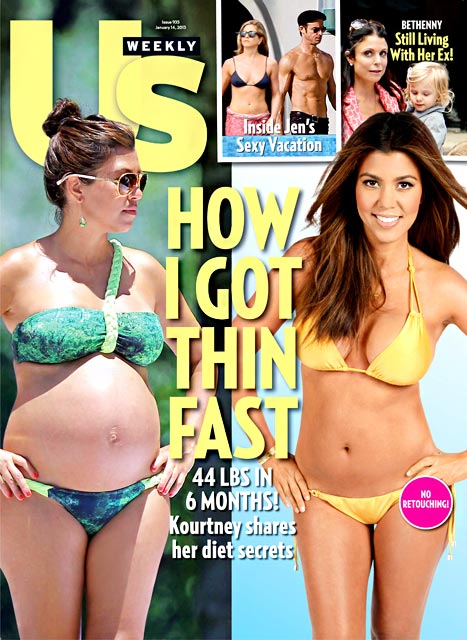
I also want to include magazine covers about losing weight in an X number of days and celebrity diets.  Many of these tabloids attract women and it makes them feel like they can do it because their favorite celebrity did it.  However, these methods do not work for the average American.  This affects the way we view our own bodies and our health choices.  The magazine cover shown above shows how misleading media is with their information.  The photo of Kourtney Kardashian on the left shows her pregnant and the photo on the right shows her after the pregnancy, or perhaps even a photo they never released from before the pregnancy.  After you give birth, a substantial amount of weight will be lost.  However, this cover gives the idea that she lost a lot of weight really fast.  This cover also gives the public the idea that we should all be thin, so follow Kourtney's tips.


Women in the White House

The percentage of women in the United States government is embarrassing. Based on a chart created by Inter Parliamentary Union, the United Stated of America is #80 in a list ranking in their respective lower and upper house of Senate or Parliament. Countries notorious for abusing women rights, such as Iraq, Afghanistan, and Saudi Arabia all rank above the US.


I want my final project to bring this information to the masses, and do more than just deliver it. I plan on designing a T-Shirt that promotes gender equality, and lets people know that America doesn’t even crack the top 40% when it comes to women in government. I will sell the T-Shirt and donate all profits to an organization is helping bridge the gap. I first thought of The White House Project, but they’ve actually run out of funding and were forced to shut down early this year. In a press release announcing the closing of their doors, they mentioned that they will continue to work with two others organizations working towards the same cause.

“[O]ur work will continue as it transitions to other organizations," the group's outgoing president, Tiffany Dufu, said in an online statement pointing to the Levo League and noting that "Vote Run Lead is being launched as a new organization to continue the political leadership training" previously provided by the White House Project.

The Levo League is a "startup designed to elevate young women in the workforce by providing the career resources needed to achieve personal and professional success," mainly focused on Gen Y women and those just starting their careers. Vote Run Lead describes itself as "the country's largest nonpartisan civic and political training program," and worked in close partnership with the White House Project for the past decade to train women considering in pursuing political careers.”

I’m still debating on which of the two I will donate my procedes to.
My timeline is as follows:

October: Finalize t-shirt design, decide which organization I will contribute to.
November: Prepare e-marketplace. Place initial order of T-Shirts. Start Instagram, Twitter, and Facebook                     pages promoting the T-Shirt and delivering the message.

December: Launch.

Final Project: Women's Magazines


"Though many writer have pointed out that women's magazines reflect historical change, fewer examine how part of their job it to determine historical change as well. Editors do their jobs well by reading the zeitgeist; editors of women's magazines-and increasingly, mainstream media as well - must be alert to what social roles are demanded of women to serve the interests of those who sponsor their publication. Women's magazines for over a century have been the most powerful agents for changing women's roles, and through out that time - today more than ever- they have consistently glamorized whatever the economy, their advertisers, and during wartime, the government, need at that moment from women." Naomi Wolf, The Beauty Myth 


I've spent years buying magazines, interning at magazines and stacking excess magazines in "decorative" piles in my room but I spend little time looking at them critically. I think when I look at magazines, even fashion magazines, I don't look at the impact they might be having other than images that might be misogynistic or feature too thin models but I think the above quote encompasses a lot of the ideas I'd like to explore in my final project. 


I'd like to look at major women's magazines and the messages they are try to get across. Instead of looking at the advertising, I'd like to focus on the cover stars, the cover stories as well as some of the other factors that may be affecting women's magazines such as going digital and maintaining readership. Magazines are often trying to sell you an image or a lifestyle, so what lifestyle are today's women's magazines trying to sell? I think the best way to do this is of course research the current most popular women's magazines and the creative and business aspects of the magazines, for example Cosmopolitan recently hired a new editor in chief and editorial staff, how has the magazine changed "under new management"? I'd like to present a brief slideshow or video and maybe an accompanying magazine briefly chronicling the major changes in women's magazines over the past couple of decades.

update:

Print Magazine: Outline
Cover
Table of Contents
Letter to the editor - Intro to the project, magazines that will be featured, project purpose
Magazine history/statistics - a brief overview of the history of the magazines I have chosen, including controversies, editorial staff, historical moments, 
"Mixed Messages" - Cover headlines from magazines, Cover star statistics
Fashion/Beauty/Health - Body image, health, dieting - What type of body image are magazines promoting? Are they promoting diets for health or vanity?
Love/Career/Life
Can women's magazine's be taken seriously? - A look at the range of serious content in women's magazines 
The Alternatives - Web and print alternatives to mainstream magazines