Saturday, November 2, 2013

Women Media Arises

          Women are underrepresented and misrepresented in the media.  Furthermore, the concurrent media constantly reinforces these caricatures of women that disempowered them socially, politically, and economically.  In order to counteract the effects of the media, alternative media surfaced.  However, for the goal to come into fruition, the alternative media must not reflect "what already exists", but to re-marginalize and "alter" our present understandings (Bell Hooks).

          Literary works are open to interpretation and when these works are remediated into films, they are expressed uniquely based on the cognition of the film crew.  Despite the expression of literary creations being all different depending on the film staff, the majority of them are males; the "signature" of product varies significantly depending on the gender of the interpreter (Maggie Humm).  By proliferating female into positions that have authority in the design of the media production, an alternative media is produced as a result that caters to the realities of women.

Different genders, different narratives

          Although "gynocriticism" offers a surrogate media, they are hindered by fiscal support (Maggie Humm).  Financial supporters of women's media are slowly increasing but the amount available in the pool is limited and sometimes lead to contention amongst women media groups for financial assistance.  In addition, they are "threatened" by media consolidation by established media corporations that wish to regulate all forms of information distribution (Debra Zimmerman).

           Another form of alternative media is independent news, a media source that is not financially supported by groups in exchange for any sort of profit.  The independent news, truthout is an example of such media source.  They provide news that are not deemed mediagenic by the mainstream, which attracts those who are interested in hearing the untold narratives of various events across the globe.  Perhaps the most intriguing aspect of truthout pertains to the majority of their staff consists of females, which might potentially bring in a different direction of how their news get published.


          Nevertheless, the media group is not without debatable flaws.  Truthout claims to be "free of bias", but can any interpretation of information be truly without any prejudice?  The current state of truthout seems to be contradictory of their claim, for as they gained more support from the number of readers, they expanded the range of their services.  Most of these new services are highly-opinionated news, such as the "Opinion", "Speakout", and "Progressive Picks" sections.   

Introduction "Making Movie Magic" from Reel to Real by bell hooks
"Author/Autor: Feminist Literary Theory and Feminist Film" by Maggie Humm
"Women Make Movies" Debra Zimmerman

Experimental Women

 Alternative media differs from mainstream media in an abundance of ways. Not only do alternative media sources provide information easily found on commercial or government owned applications, they also bring forth the flip-side of topics and controversial issues that are often neglected and steered away from. Alternative media gives people who do not necessarily fit into the cookie cutter mold set forth by prevailing mass media a voice that is capable of reaching the general public, that would otherwise be muffled and unheard. Alternative media can be extended to all facets of media communication; television, radio, newspapers, magazines, internet, and film. Independent, experimental, avant-garde cinema is one form of alternative media that exists out side of the typical major film studio/ Hollywood narrative cinema, that deconstructs the structure of cinema that we as audience members have grown so accustomed to.

This deconstruction of society's commercially manifested notions of 'cinema norms' extends to the employment opportunities available and fulfilled by women working with in the media. According to a study collaborated by Sundace Institute and Women in Film Los Angeles, “the percentage of female directors at Sundance is significantly higher than that of the top 100 films at the box office”, with percentages of 23.9 versus 4.4 (Indie Wire). The study also found that women were 34.5 percent more likely to direct while having more women behind the cameras as cinematographers, writers, producers, and editors. Although the survey only examines the prevalence of women filmmakers present at the Sundance festivals between the years of 2002 and 2012, this is not a phenomenon so unfamiliar with the past.

(Still from Introspections)

Women such as Marie Menken, Maya Deren, and Sara Kathryn Arledge are considered the “foremothers of experimental cinema”, with their works dating as early as the late 1930's extending all the way to the mid 1980's (Alternative Projections). These pioneers of experimental film boldly went against the mainstream forms of cinema dominant at the time, and managed to provide equally (if not more) thought provoking work in relation to their commercial box-office competitors. Sara Kathryn Arledge's films, What is a Man? (1958), and Introspections (1947), uses interpretive  dance, social satire, and experimental/ alternative methods as an attempt to recreate life and reality artistically that both directly challenges and criticizes formal gender conventions. These two films employ the use of mysterious, chaotic, psychedelic, and even disturbing visual compositions, essentially unseen in commercial Hollywood, big budgeted films. In 1956, Arledge's film What is a Man?, which was started in 1951, received the Creative Film Foundation award for best script (Filmmaker's scoop).

 Maya Deren, is another woman who drastically shaped and promoted the progression of independent- experimental cinema from early on. In terms of production, Deren did it all; directing, filming/ shooting, recording, performing, and editing. Every detail was her decision- her experimentation. Originally named Eleanora Derenkowsky, shortly after Deren's "first and most remarkable experimental film, Meshes of the Afternoon (1943)", she changed her name to 'Maya Deren' (Maya meaning 'illusion' in Buddhism), as a means to fully encompass herself in her work (Senses of Cinema). Indeed, experimental film can be seen as an illusion, often times providing the audience with highly staged scenes that one may deem to unrealistic/abstract/out of the ordinary to depict reality. However, this is not the case for Arledge nor Derne. Meshes of the Afternoon, created in the early forties, illuminates the paranoia and confusion prevalent society during a period of wartime, while also criticizing and commenting upon the formal/commercial structure of Hollywood cinema.

Maya Deren
 Although experimental and independent films may not always blatantly cause the audience to reflect onto their environments, behavior, and societal views, they perform on a more subconscious and indirect level. Bell Hooks argues that it is this very essence of creative art that provides the most compelling emotions and thoughts, stating that; "the less a work of art reflects the world, the more is being in the world and having its natural being like anything else", she goes on, "film must be free from all imitations, of which the most dangerous is the imitation of life" (Hooks, 1). It is through challenging what is forced fed to us through big-budgeted, government-owned, mass produced media, rather than perpetuating it, that we get a better understanding of  the nature of society, culture, nation-states, controversies, and social conflict.  

Part of meshes of the Afternoon

Work Cited:

  • (Indie Wire) Willmore, Alison. "More Female Filmmakers in Indie Film Than in Hollywood, According to a New Study." Indiewire. N.p., 21 Jan. 2013. Web. 02 Nov. 2013. <http://www.indiewire.com/article/television/more-female-filmmakers-in-indie-film-than-in-hollywood-according-to-a-new-study-from-the-sundance-institute-and-women-in-film-los-angeles>. 
  • (Alternative Projections) "Sara Kathryn Arledge." Alternative Projections. The Getty, n.d. Web. 2 Nov. 2013. <http://alternativeprojections.com/data/peopleDetail.php?id=Sara%20Kathryn%20Arledge>. 
  • (Filmmaker's scoop) "The Film Makers Cooperative." The Film Makers Cooperative. N.p., n.d. Web. 02 Nov. 2013. <http://film-makerscoop.com/rentals-sales/search-results?fmc_author=31>. 
  • (Senses of Cinema) Haslem, Wendy. "Maya Deren." Senses of Cinema RSS. N.p., Dec. 2002. Web. 02 Nov. 2013. <http://sensesofcinema.com/2002/great-directors/deren-2/>. 
  • Hooks, Bell. "Making Movie Magic." Introduction. Reel to Real. London: Routledge, 1997. 1-5. Print. 


Friday, November 1, 2013

We Belong Together Organization

 
         We Belong Together is an initiative of the National Domestic Workers Alliance and the National Asian Pacific American Women's Forum, with the participation of women’s organizations, immigrant rights groups, children, and families across the country. It is a campaign to mobilize women in support of common-sense immigration reform that will keep families together and empower women. Immigration reform is rarely thought of as a women’s issue, but in fact it is central to the fight for women’s equality. Many of them already come from an area where there is slim to no opportunities for them. Millions of immigrant women who are part of the fabric of our communities, workplaces, and schools are blocked from achieving their full potential because of a broken immigration system. They perform essential jobs, like taking care of our children and our aging parents, doing our day to day grooming, cleaning, and are central to family and community well-being.
Our current immigration system is not working for people born in the United States or for people born abroad. Any meaningful reform of our immigration system must include a fair and generous process that ensures that immigrant women have the opportunity to take care of themselves and their families, and bring their numerous contributions and talents to strengthen America. Specifically, immigration reform legislation must:
  • Include a broad and clear road map to citizenship that recognizes the contributions of women’s work and women workers.
  • Keep all families together.
  • Recognize women’s work in future employment categories and protect women workers on the job.
  • Ensure protections for survivors of violence and trafficking.
  • Protect families and ensure due process.
  • Promote immigrant integration that includes and empowers women.
We Belong Together was formed on Mothers Day in 2010, when a group of women traveled to Arizona in the wake of the passage of the anti-immigrant law SB1070, to investigate how the new law would affect women, children and families in that state. What we heard were stories of abuse, of inhumane treatment and forcible, traumatic separation of mothers from their families, and children from their parents. In July of 2010, they organized a Congressional briefing to bring those stories to Washington, DC.
This organization has been necessary because it has changed many lives, and has helped make change in the U.S.A. Their determination and ambition has helped bring attention and uproar into the case of immigrant women getting their rights in America. I heard about this organization in my gender and immigration class and was amazed at the progressed that was made. There main focus was helping organize people to help stand against the abuse of nail salon workers. They would work 10 hours plus a day without a break, and when the worker would speak they would be fired. This organization helped people find justice. Though there is still much work to be done in that field, this is a great start.
 Check out there website:http://www.webelongtogether.org/about
https://bbhosted.cuny.edu/bbcswebdav/pid-14880691-dt-content-rid-27411853_1/courses/HTR01_WGSL_20600_01_1139_1/theprogressive_sept13.nailsalon%20%281%29.pdf

Changing How We See Images: An Argument for Alternative Media


"Changing how we see images is clearly one way to change the world," bell hooks tells us in "Making Movie Magic" (6).
Representations of Women in Media
Let's think about that.
How do we see images? Specifically, images of womanhood? How is woman portrayed? Is she portrayed at all? Is she part of the discourse, of our shared starting point?
When talking about her students, bell hooks realizes that they learned more about "race, sex, and class from movies than from all the theoretical literature" she was urging them to read, and furthermore, that movies also provided "a shared experience, a common starting point" to talk about such charged issues (2). While she is referring to movies in that quote, the same can be said for any mainstream media.
More and more, we are realizing that the portrayals of women we see in the media isn't accurate in the least and that this is shaping our culture, our starting point and our identities. This isn't new information. For the most part, it is widely understood that women have been underrepresented and misrepresented across media. Mainstream media has worked hard to keep the status quo of women as subservient homemakers or otherwise, submissive sexual objects and perpetuate the ideals that women are somehow inherently less than men. Here's a new idea: it might help to have women tell women's stories (in the correct proportions, not just 17%!). Megan Kamerick discusses this a bit in her Ted Talk: http://www.ted.com/talks/megan_kamerick_women_should_represent_women_in_media.html
This is precisely why alternative media is so important. As artists and creators, we need to stop fearing that "thinking politically about...(a) work will interfere with some 'pure' vision" and realize instead that "thinking in a constructive way about accountability...strengthens and enhances (the work)" (hooks, 8-9). We need to realize that while it may be very hard to make the deservedly big dent in mainstream media, we can still make our voices heard through "multi-media technologies, including the Internet, and the growth of new cable channels" (Zimmerman, 265).
 

Still, it may be argued that even women can misrepresent other women. This is quite true. It was seen with the first wave of the women's movement which distinguished between the women's suffrage movement and the civil rights movement as two separate things, thus alienating black women. (Note: this still goes on today, see
Another example of this is expressed in Maggie Humm's article, "Author/Auteur: Feminist Literary Theory and Feminist Film." Humm describes a troubling authorial signature in Marleen Gorris' (pictured above left) representation of racial difference in A Question of Silence. According to Humm, Gorris others Surinamese prostitute, Tessa, by making her "stereotypically exaggerated" and framing her "in medium shot sitting passively at the far end of the brothel bar, an isolated silent figure" (Humm, 105).

 
And more to the point, THIS is why we need alternative media sources such as ColorLines Magazine. Founded in 1998, initially as a bimonthly print publication, ColorLines covers topics on race, gender and politics (and everything in between) in society. In 2010, the publication became an online magazine, and still, it has provided prize-winning articles that promote social justice and positive social change while giving us in-depth analyses of topics ranging anywhere from white privilege to immigration reform, rape culture, and twerking and how these relate to women of all classes, races, sexualities etc. Early feminist movements focused solely on sex and disregarded all the other ways in which women were oppressed. ColorLines Magazine does the exact opposite. This publication seeks to bring up those topics instead and put them in plain view, no sugar-coating or beating around the bush. That is what is so compelling and necessary about this source of alternative media. With this source of alternative media, we get relevant topics that affect women on a deep level. The following article deals with women and immigration reform, a topic that has special significance lately with the DREAM Act and all the immigration reform that has been going through and been fought to go through. Still, this article touches specifically on how this issue affects women: http://colorlines.com/archives/2013/10/women_immigration_reform.html. This next article deals with women in the construction job arena. How often do we hear of this? I'd say not often at all, but it is something that is happening and that affects women in real life. It is significant that we have a source that tells us these stories: http://colorlines.com/archives/2013/10/women_in_construction_35_years_after_affirmative_action.html. So many of the articles featured on this website have so much social significance to women. Recently, we read about women directors and women in film. Out of four women nominated for a Best Director Academy Award, Sofia Coppola was one of them. Her movie The Bling Ring is discussed in the following article. Another instance of white-washing in movies, once again, why can't we as women present all women exactly as they are (even if in a bad light) but at least give minority women the opportunity to play themselves in a role. If our female directors that have made big names for themselves keep treating the films they make with that anxiety that Maggie Humm described Gorris having in Broken Mirrors, how can we expect any better from our male counterparts? We are definitely still part of the problem if we are white-washing roles on our films :http://colorlines.com/archives/2013/06/who_you_wont_see_in_sofia_coppolas_the_bling_ring.html. Let's not forget rape culture, or what our patriarchal definition of gender (in this case manhood) has done to our men. This kind of mentality and the reinforcing it, has deep and impactful consequences on how women get treated. This piece about Chris Brown saying he lost his virginity when he was 8 is clearly significant, especially given his history of violence and though a story seemingly about men only, treating rape in this way has lasting effects on women: http://colorlines.com/archives/2013/10/chris_brown_2.html.


Works Cited:

hooks, bell. "Making Movie Magic"
Humm, Maggie. "
www.colorlines.com


post 3 revised


Although the readings done from this class may have been written before the birth of myself and my classmates, they are more true now than ever before about advertising images and their power over women and their self esteem. Our modern world hurls more idealized and photoshopped images of women than ever before, the magazine and print world is becoming dated--women are bombarded with more self destructing and deadly images online.
Something I found interesting in Gloria Steinem’s  “Sex, Lies and Advertising” reading was the fact that the advertisements not only funded the magazine, but directed its content. Steinem outlined her various experiences with companies that refused to advertise with Ms. Magazine because of its feminist thoughts and intellectual readers broke the hetero-normative formula that is tried and true in other female-centric publications. The companies didn’t agree with the open forum of thought, and many of the articles published- a primary reason they refused for their ads to be placed. This was very revealing to me that advertisements aren’t just strewn about the latest issue of Glamour, but encoded into the articles as well. “Agreed to try the ad-free, reader-supported Ms. you hold now and to give us complete editorial control” (Steinem 120) This states that magazines with advertisements are not unique in thought, and articles are being used to sold products subliminally- readers can’t decipher an ad from an article! 
Found in the advertisements (and articles) in the magazines we devour, the online realm, and on television are a medley of stereotypes surrounding femininity. There is the archetype of the “mother/nurturer” someone who equates love with food, and who would rather serve her family than eat in public. Flipping John Berger’s “men act, and women appear” to “men eat and women prepare”(Bordo 119) Also as discussed in class, the fact that women should be seen and not heard, the “more you subtract the more you add.” Contradicting this a woman must be small in personality as well as quiet, but express herself in things she has control over, clothing makeup etc. Advertising is designed to put women down, make them insecure about themselves, and offer a material solution to the physical problems they strategically pointed out. 
And we believe it! And we feel insecure! Knowing better, we have all heard about the photoshopped images, manipulated to the point where they don’t resemble who was photographed and objectified. But as stated in "Beauty and the Beast of Advertising", the women’s magazine resembles an older, trustworthy female relative, a mentor, simply because it is the “serious mass-market women’s journalism available.” (Killbourne 75) 
The authors of the articles are swayed by advertiser’s wants, offering mixed messages to the female readership. Confused by the “Love the skin you’re in” articles while simultaneously ingesting the “waif” model has deadly consequences. Instead of being taught to be forever maternal, girls are encouraged to be forever beautiful, as appearance is the most important thing they could provide. Forever young, forever innocent. 
Agelessness and lack of sexual desire are implied in this ad, where the child is objectified.
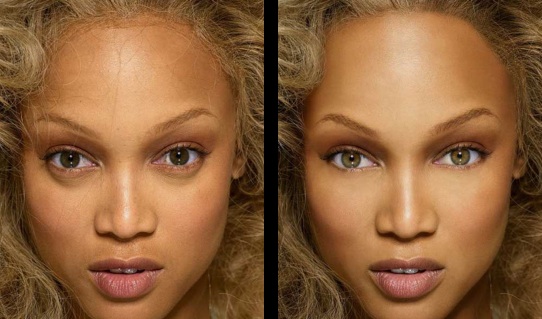
Advertising in such a conflicting and emotionally crushing won’t stop because it has proven so profitable. I think showing the viewers of the mass media just how the images that we measure ourselves against are so manipulated.  http://collegecandy.com/2012/04/21/54-photoshopped-celebrity-before-and-after-photos/#photo=2
Even Tyra can't live up to her own standard of beauty!


Works Cited:


Killbourne, Jean. "Beauty and the Beast of Advertising" Race, Class and Gender and Integrated Study. Ed. Paula Rothenberg 2nd. ed. New York: St. Martin's 1992

Steinem, Gloria. "Sex, lies & advertising." Ms 8.2 (1997):18.

Divorce Iranian Style (Post #4)

      Dwelling on our class discussion about discrimination of women, I came across an excellent documentary film Divorce Iranian Style which provides a unique window into the intimate circumstances of Iranian women’s lives. Directors Kim Longinotto and Ziba Mir-Hosseini take one inside an Iranian divorce courtroom, dispelling images of Iran as a country of war, hostages, and “fatwas”, and Iranian women as passive victims of a terrible system.

     Full movie is available for free on youtube:


     The film lets you take a peep at the forbidden act in the country where personal happiness and satisfaction of women is banned by religion. Although action mostly takes place in a tiny Islamic divorce court room, it did not make me suffocate with claustrophobia, but rather proved my assumption that most of day-to-day things would be impossible to shoot in Iran. People would, most likely, refuse to show their real life to strangers. However, court room in Iran is a place where the bravest women and those who have nothing to lose search democracy and equality with men.

     One of the brightest and most ironical moments of Divorce Iranian Style is the little daughter of the court clerk mimicking the judge sermonize an imaginary man for mistreating his wife. When asked if she’ll ever marry, she responds, “Never, now that I know what husbands are like.” To me it looks like an outburst of director’s female solidarity with the victims of the marital procedure, some of which clearly deserve more justice. However, Kim Longinotto and Ziba Mir-Hosseini could not say it openly as they were granted a special permission to film a sensitive legal procedure. Little girl mocking the judge adds a satirical pin to the film’s direct reality – very clever invisible editing trick. It makes the point without forcing it upon the viewer.

      Story is structured by showing least disturbing and quiet divorce cases followed by most outrageous ones. Female characters ventilate from friendly and flirting Massi, who tells the judge that her husband mistreats her, to the hysterical and violent Maryam, who risks losing custody of her two daughters because of the new marriage. The behind-the-scene manner of editing makes this documentary very objective and honest to the viewer. Rather than showing barbaric and patriarchal Iran of modern films like Persepolis, Divorce Iranian Style refuses to show Islamic women as powerless and escalates their inner strength and determination while lowering those of their male counterparts.

     Maryam Keshavarz, Iranian-American writer-director, said in the interview for The Telegraph that “Iran’s a country that creates women who like to cause problems, to kick up the dirt a little. Maybe it’s the way we’re raised.” Her films represent her general attitude to the repression in Iranian society. And clearly there are changes afoot. Recent reports suggest almost 60 per cent of Iranian university students are women. The divorce rate has risen steeply; more women are choosing to live alone, or share accommodation with other women. “This makes for an environment that’s drastically different from other parts of the Middle East,” Keshavarz says, “but it doesn’t remove inequality from Iranian society. The morality police still control the way people dress and behave.”

Women's eNews: "Covering Women's Issues - Changing Women's Lives"


Women in the media industry are massively underrepresented. The distribution of gender across all roles and occupations within the media is massively skewed towards men. This is not a new phenomenon; women have always played a smaller role in media production than their male counterparts, and the progression towards gender equality in this field is slow. Media content itself locates women within their ‘traditional’ submissive roles: those of the housewife and mother. News media in particular do not offer content specific to the interests of women. As such, alternative news sources aimed at delivering content for women, to women, have emerged. Increasing accessibility of the internet has enabled women to create, and access, non-mainstream long-tail news outlets that cater content to women.

One such alternative news organization is Women’s eNews, or We.news. We.news is an online news source that features articles written largely by women on a variety of subjects, including politics, health, culture, the arts, and business. These topics are indeed discussed in mainstream media, but We.news presents information that is particularly relevant to women. The site is almost entirely run by women, who comprise an overwhelming majority of writing and editing positions. Its board of directors is also almost entirely female. These women hail from a variety of ethnic and class backgrounds. We.news contributors and content have earned recognition from the National Women’s Political Caucus and the International Planned Parenthood Federation, among others. Womensenews.org was listed as one of the best websites for women by Forbes Magazine in 2011, 2012, and 2013.

Women’s eNews was founded in 1999 by the advocacy group Legal Momentum (then known as NOW Legal Defense and Education Fund). In an effort to reach women in Arabic-speaking nations, We.news created its Arabic-language site in 2002, which, aside from featuring translated articles from its English-language counterpart, presented a media outlet to which Arabic women could contribute. This greatly expanded the content of We.news, prompting it to adopt a more global perspective. We.news presents articles focusing on issues within a number of countries, including Israel, Japan, Egypt, Turkey, and Tanzania. These articles address a wide variety of subjects, such as land ownership rights, gender parity, sexual harassment, and abortion legislation.


Women’s eNews is a necessary alternative to mainstream media. It is a site dedicated to the in-depth coverage of topics of concern to women neglected by mainstream media. By marketing itself specifically to women, it is able to reach its target demographic. Women’s eNews obtains much of their content from freelance writers, allowing it to have a broad selection of articles and topics to choose from and post. Furthermore, women are prevalent in all media production roles, from the board room to the writer’s desk. It is this last point that speaks to the success of We.news. It is a space that encourages women writers to tackle women’s issues in a forum policed and viewed by women. Without the involvement of women at every level of the organization, Women’s eNews would fail in providing the alternative to mainstream media that it offers.

Mainstream media, by virtue of being mainstream, have sparked the creation of a variety of alternative media that seek to fill gaps in coverage and strive to meet the needs of marginalized demographics. Women’s eNews is just one example of such an organization. Today’s media landscape, which includes the increasingly populated and popular internet, allows for such organizations to exist and thrive. It is likely that sites like We.news will continue to be necessary for some time, as mainstream media is slow to expand and adapt its content to cater to women and minority groups.


“The Pope Blinks; Afghan Police Harass Women.” n.p. Women's eNews, 21 Sept. 2013. Web. 31 Oct. 2013.

Casserly, Meghan. "The 100 Best Websites For Women, 2013." Forbes. Forbes Magazine, 20 Aug. 2013. Web. 31 Oct. 2013.

Makino, Catherine. “Japanese 'Aunties' Party Presses for Gender Parity.” n.p. Women's eNews, 23 Sept. 2013. Web. 31 Oct. 2013.

McCabe, Jess. “Tanzanian Women See Second Chance at Land Owning.” n.p. Women's eNews, 30 Oct. 2013. Web. 31 Oct. 2013.


Oberoi, Reshmi Kaur. "Southwest Takes the Legal Battlefront on Abortion." n.p. Women's eNews, 31 Oct. 2013. Web. 31 Oct. 2013.